Molecular Fingerprints in Natural Products to Address Alzheimer’s disease
 Nuhash Gazi
•
Nuhash Gazi
•
Alzheimer’s disease, the leading cause of dementia is a multi-pathology disorder involving amyloid-beta plaques, tau hyperphosphorylation, oxidative and mitochondrial stress, neuroinflammation, and ultimately neuronal death. Because these pathologies interact, a single-target therapy does not address the full disease network. More than 55 million people worldwide are currently living with Alzheimer’s disease, which is expected to triple in the next 25 years.
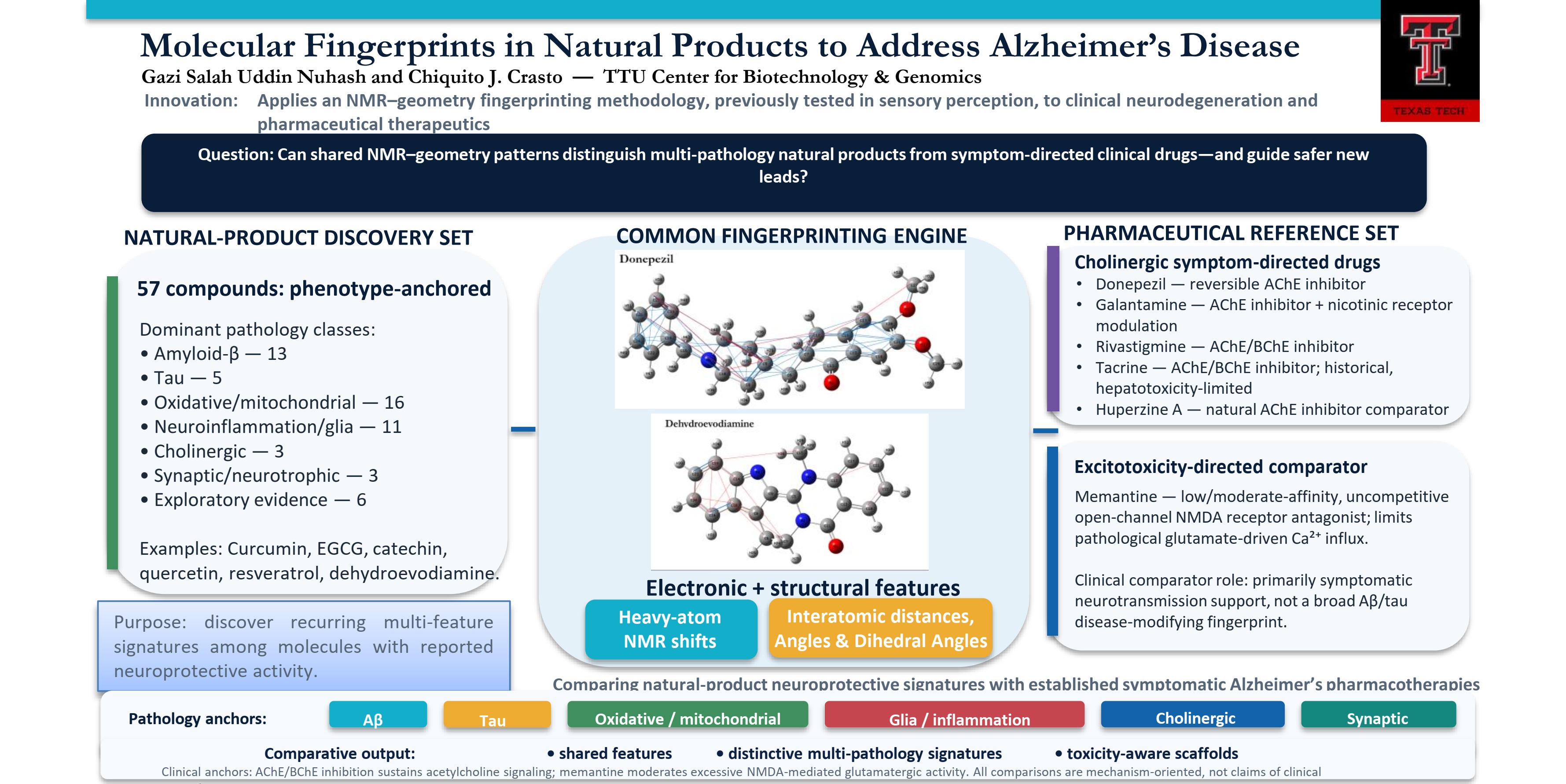
We have developed a Novel methodology to identify molecular fingerprints, and have applied it to 57 naturally occurring active ingredients reported in literature to address Alzheimer’s disease, and six commonly prescribed pharmaceutical products for Alzheimer’s patients. By fingerprints, we mean structural-electronic features within the molecules and go beyond their overall structural constituents. By applying this method, we are exploring specific atomic level fingerprints that can be used as references to develop new classes of compounds that leverage the curative effects of natural products. Hence, my project asks whether neuroprotective molecules share measurable structural and electronic features, which we are naming ‘molecular fingerprints’.
This methodology is universal as it was successfully deployed to uncover sensory perception of taste in flavor profiles of spices, which has been recognized by the American Chemical Society.
The first component of the fingerprint is the NMR chemical shift, which is a measure of the local electronic environment around an atom. The interatomic distances and angles constitute the structural geometry component of the fingerprint.
This is illustrated by comparing Donepezil, an established and baseline Alzheimer’s drug, and dehydroevodiamine, a natural-product alkaloid. They differ in their structures but share highlighted intramolecular relationships around their aromatic frameworks. Red lines represent fingerprints associated with pharmaceutical products; blue lines represent fingerprints associated with natural products. Their short-to-intermediate geometric relationships suggest that chemically distinct molecules can share local electronic–geometric motifs relevant to neuroprotective activity. Donepezil is more extended and oxygen-substituted, while dehydroevodiamine is compact, fused, and nitrogen-rich. The method therefore seeks recurring local patterns, rather than complete structural similarity across the selected molecules.
The outcome will be a toxicity-aware map of shared and distinctive molecular fingerprints to prioritize safer scaffolds, guide analog design, and generate new hypotheses for potential novel products for neurodegenerative drug discovery.
YouTube Video Link: https://youtu.be/f79Pu1-52-4?si=CqxdIawOZHgF2eOg
We have developed a Novel methodology to identify molecular fingerprints, and have applied it to 57 naturally occurring active ingredients reported in literature to address Alzheimer’s disease, and six commonly prescribed pharmaceutical products for Alzheimer’s patients. By fingerprints, we mean structural-electronic features within the molecules and go beyond their overall structural constituents. By applying this method, we are exploring specific atomic level fingerprints that can be used as references to develop new classes of compounds that leverage the curative effects of natural products. Hence, my project asks whether neuroprotective molecules share measurable structural and electronic features, which we are naming ‘molecular fingerprints’.
This methodology is universal as it was successfully deployed to uncover sensory perception of taste in flavor profiles of spices, which has been recognized by the American Chemical Society.
The first component of the fingerprint is the NMR chemical shift, which is a measure of the local electronic environment around an atom. The interatomic distances and angles constitute the structural geometry component of the fingerprint.
This is illustrated by comparing Donepezil, an established and baseline Alzheimer’s drug, and dehydroevodiamine, a natural-product alkaloid. They differ in their structures but share highlighted intramolecular relationships around their aromatic frameworks. Red lines represent fingerprints associated with pharmaceutical products; blue lines represent fingerprints associated with natural products. Their short-to-intermediate geometric relationships suggest that chemically distinct molecules can share local electronic–geometric motifs relevant to neuroprotective activity. Donepezil is more extended and oxygen-substituted, while dehydroevodiamine is compact, fused, and nitrogen-rich. The method therefore seeks recurring local patterns, rather than complete structural similarity across the selected molecules.
The outcome will be a toxicity-aware map of shared and distinctive molecular fingerprints to prioritize safer scaffolds, guide analog design, and generate new hypotheses for potential novel products for neurodegenerative drug discovery.
YouTube Video Link: https://youtu.be/f79Pu1-52-4?si=CqxdIawOZHgF2eOg